Can GLP-1 drugs change alcohol cravings, mood, and motivation?
Less interest in alcohol can be welcome. Less interest in everything is a different concern. Here is what the human research can—and cannot—tell us.
The short answer: promising for drinking, a more complicated story for mood
Imagine starting a weight-loss medicine and noticing that the evening beer no longer sounds especially appealing. That might feel like a useful change. Now imagine losing interest in music, seeing friends or doing something you usually love. Both experiences get described online as a change in “reward,” but they raise different clinical questions.
Randomized semaglutide trials now provide evidence of reductions in some alcohol outcomes. The findings are not uniform across studies or endpoints. Meanwhile, substantial safety analyses have not found an overall increase in depression or suicidal behavior with the GLP-1 drugs studied. Neither conclusion establishes that these medicines treat depression, or that an individual cannot experience a troubling change in mood.[2][3][4][6]
The distinction to keep: craving, consumption, enjoyment, motivation and fatigue are separate outcomes. A study measuring one cannot quietly become proof about all five.
This article follows the evidence through those separate questions. It includes negative results, distinguishes treatment-seeking patients from volunteers who were not seeking alcohol treatment, and keeps semaglutide findings separate from assumptions about tirzepatide and retatrutide.
What do you mean when you say “I feel flat”?
The urge to seek something, such as alcohol. A lower urge does not necessarily mean less enjoyment across the rest of life.
Reduced interest or pleasure in normally enjoyable activities. It deserves attention, especially when persistent or affecting daily functioning.
Feeling exhausted or lacking energy. Someone can want to do an activity and still feel too tired to do it.
The willingness to initiate or sustain an activity. This is related to, but not interchangeable with, energy or enjoyment.
Depression involves a pattern of symptoms, duration and impact on life. Reduced enjoyment can be part of that pattern, as can low energy, sleep changes and difficulty concentrating. One symptom alone does not identify its cause. A person who says “I’m not hungry” is describing something different from someone who says “I no longer enjoy anything.”[12]
For readers trying to interpret their own experience, specific descriptions are more useful than a theory about dopamine. Are you less interested in alcohol? Too nauseated to eat? Physically tired? Still enjoying things once you get started? Or finding that the enjoyment itself has disappeared? Those distinctions help a clinician work out what needs evaluating.
A plausible brain mechanism is a starting point
The interest in GLP-1 and addiction did not begin with weight-loss testimonials. Preclinical experiments found changes in alcohol intake and reward-related responses. In one semaglutide study, rats drank less and showed less relapse-like drinking; related experiments examined alcohol-induced dopamine responses in mice. These findings offer a biological rationale for human trials. They do not demonstrate that people experience a generalized depletion of dopamine.[8]
“Reward” also describes several different experimental measurements. An animal choosing less alcohol, a brain region responding differently to an alcohol image, and a person enjoying a conversation are not interchangeable tests. A mechanism can suggest what to study, but patient outcomes determine whether the intervention is useful.
Electronic health records add another kind of evidence. A 2024 study associated semaglutide use with fewer new or recurrent alcohol-use-disorder diagnoses. Because treatment was not randomly assigned, differences in prescribing, healthcare engagement and patient characteristics could influence that association. Matching groups statistically helps; it cannot turn an observational comparison into a randomized trial.[9]
Inside the alcohol trials: read the endpoints, not just the headlines
The strongest way to evaluate the claim is to ask which drug was tested, who enrolled, what support they received and which outcome was designated in advance. A reduction in drinking quantity can matter even if abstinence does not increase. Conversely, a positive exploratory measure should not erase a negative primary endpoint.
2022 · Exenatide · 127 participants · 26 weeks
An important negative primary result
Participants with alcohol use disorder received exenatide or placebo alongside cognitive behavioral therapy. Exenatide did not significantly outperform placebo on the primary heavy-drinking-days outcome. An exploratory obesity subgroup appeared to benefit, but subgroup findings require confirmation. A small imaging substudy showed altered responses to alcohol cues; that did not rescue the negative overall clinical endpoint.[1]
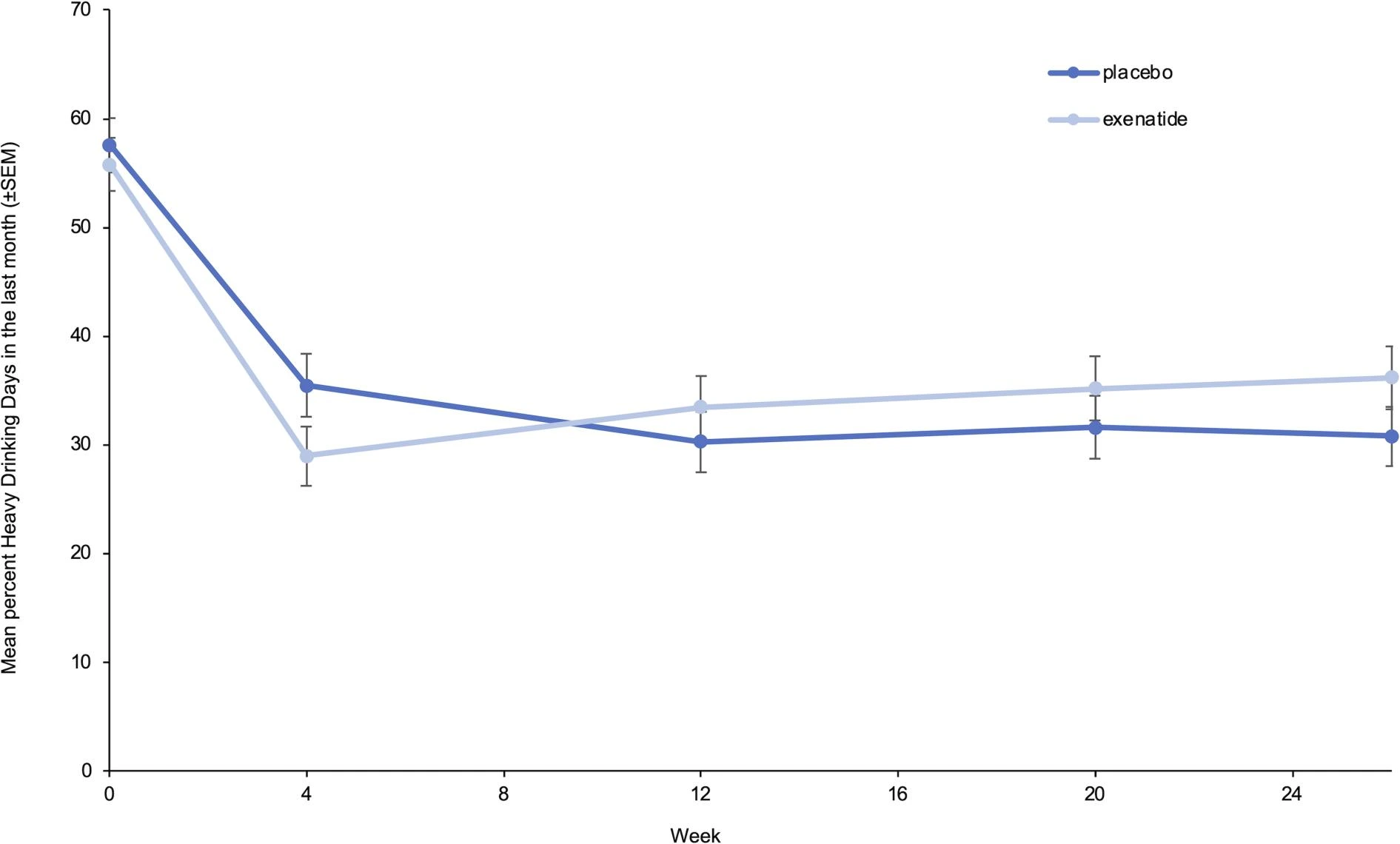
Reproduced from Klausen MK et al., JCI Insight (2022), Figure 3. © 2022 Klausen et al., CC BY 4.0. Converted to WebP for loading speed; figure content unchanged. Tap the chart to enlarge.
2025 · Injectable semaglutide · 48 participants · 9 weeks
A positive laboratory signal, with limits
Hendershot and colleagues enrolled adults with alcohol use disorder who were not seeking treatment. Semaglutide reduced alcohol consumed in a laboratory self-administration task. Some real-world measures, including drinks per drinking day and craving, also improved. However, drinks per calendar day did not significantly improve, and the proportion of drinking versus abstinent days did not change. Several weekly findings were exploratory. This was a small, short trial, not evidence of durable remission or an established addiction-treatment regimen.[2]
2026 · Injectable semaglutide · 108 participants · 26 weeks
A trial in treatment-seeking adults with obesity
A Danish placebo-controlled trial tested semaglutide alongside cognitive behavioral therapy in people with alcohol use disorder and obesity. The estimated treatment difference in heavy-drinking days was −13.7 percentage points, with a 95% confidence interval from −22.0 to −5.4. This strengthens the clinical case, while leaving questions about people without obesity and longer-term outcomes.[3]
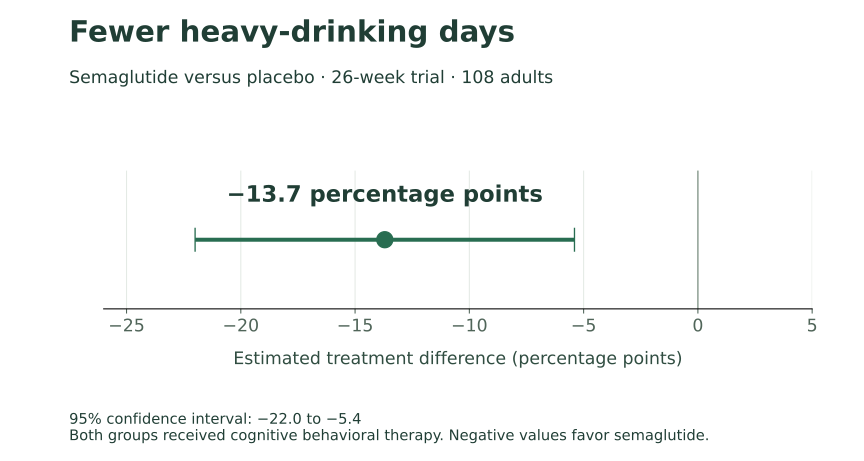
Original PED Evidence graphic using the reported model estimate and confidence interval from the 2026 randomized trial, PMID 42070571. Not a reproduced publisher figure.
View the chart data
| Measure | Reported value |
|---|---|
| Estimated treatment difference | −13.7 percentage points |
| 95% confidence interval | −22.0 to −5.4 |
| Randomized participants | 108 |
2026 · Oral semaglutide · 50 participants · 8 weeks
Better drinking outcomes did not mean every craving test improved
Schacht and colleagues studied treatment-seeking adults with moderate-to-severe alcohol use disorder. Oral semaglutide did not significantly improve the primary laboratory cue-elicited craving endpoint. It reduced heavy-drinking days, a prespecified secondary outcome, but not drinks per calendar day. Other measures, including everyday craving and drinks per drinking day, favored treatment. The lesson is not to dismiss the study: it is to describe the mixed findings accurately and distinguish primary, secondary and exploratory outcomes.[4]
Together, these trials justify serious interest. They also show why “GLP-1 drugs switch off addiction” is too broad. The drug, formulation, population, duration and measure all matter. A positive result should lead to a more precise question: who benefits, by how much, for how long, and with what tradeoffs?
What do the depression and psychiatric-safety studies show?
The STEP psychiatric-safety analysis included 3,377 participants from STEP 1–3 and 304 from STEP 5. It did not find an increase in depression symptoms or suicidal ideation/behavior with semaglutide versus placebo. However, these were weight-management trials in people without known major psychopathology, with low average depression scores at baseline. Important psychiatric exclusions limit generalization to people with severe or unstable illness.[5]
A broader FDA review of 91 placebo-controlled trials, including 107,910 participants, likewise found no increased risk of suicidal ideation/behavior or relevant psychiatric events such as depression, anxiety, irritability or psychosis. The agency requested removal of the suicidal-behavior warning from affected GLP-1 weight-management labels. That is meaningful reassurance at the population level.[6]
But a reassuring depression analysis is not a dedicated test of emotional blunting. A trial could measure overall depression severity without comprehensively measuring social enjoyment, effort, anticipation and pleasure. It is therefore too strong to infer that anhedonia has been disproven in every individual. It is equally too strong to treat online reports as proof of a frequent, dose-dependent syndrome.
Nor does the absence of increased depression establish an antidepressant effect. A trial enrolling patients with depression and measuring a clinically meaningful treatment outcome answers a different question from monitoring psychiatric safety during weight loss.
Both observations deserve room: large studies can be reassuring overall, and a particular person can still need help with symptoms that appeared after treatment. Clinical review should investigate the experience rather than dismiss it or assign a cause before assessing it.
Can the dose make someone feel worse? Separate fatigue from anhedonia
Fatigue is a documented adverse reaction with tirzepatide. In pooled Zepbound weight-reduction trials, the reported rates were 3% with placebo and 5%, 6% and 7% with the 5, 10 and 15 mg treatment groups. The category includes weakness, lethargy and malaise. These numbers describe fatigue events—not emotional blunting or depression.[7]
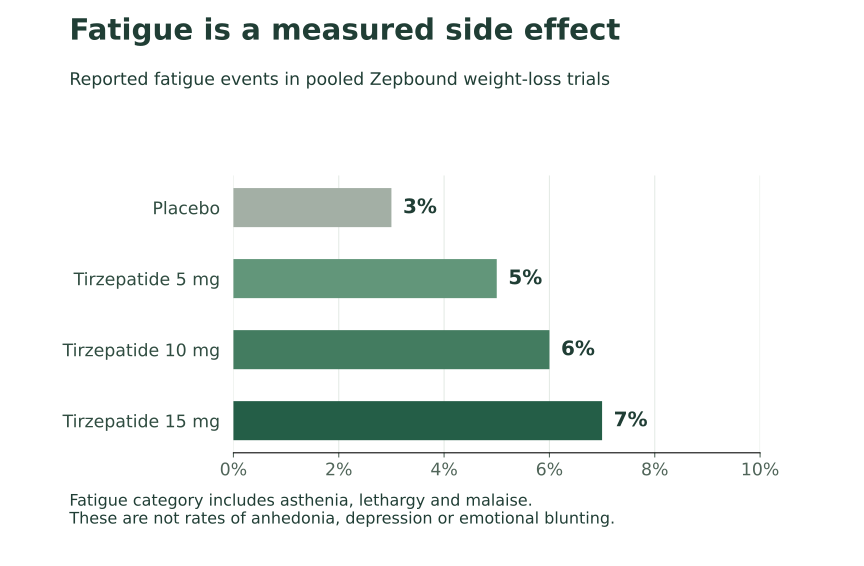
Original PED Evidence chart. Data: FDA Zepbound prescribing information, Table 1. Group sizes: placebo 958; 5 mg 630; 10 mg 948; 15 mg 941.
View the chart data
| Group | Reported fatigue |
|---|---|
| Placebo | 3% |
| 5 mg | 5% |
| 10 mg | 6% |
| 15 mg | 7% |
The same prescribing information documents gastrointestinal adverse effects, often during dose escalation, and dehydration-related problems. A symptom that follows an increase is worth discussing with the prescriber. It does not by itself establish the mechanism, and these data cannot tell us that lowering a dose reliably reverses anhedonia.[7]
A useful conversation begins with a timeline: what was present before treatment, what changed, and what else changed at the same time? Food intake, sleep, drinking, other medicines and physical symptoms all belong in that account. The goal is to identify an explanation that fits the whole picture, rather than to decide in advance that every symptom is either the drug or the calorie deficit.
Semaglutide, Tirz, Reta and brenipatide are not interchangeable evidence
The direct alcohol trials discussed above tested semaglutide or exenatide. Tirzepatide activates GIP and GLP-1 receptors; retatrutide adds glucagon-receptor activity and remains investigational in the development information reviewed here. Shared GLP-1 activity supports a research hypothesis. It does not establish the same effects on alcohol, depression or motivation, and the number of receptor targets does not rank psychiatric benefit.[7][13]
Brenipatide makes this distinction especially relevant. Its RENEW-MDD-1 trial tests the drug with standard care against placebo with standard care, aiming to delay the return of major depressive symptoms. The listing describes a Phase 3 trial, not a completed antidepressant result. It also excludes people with recent moderate or severe substance/alcohol use disorder, limiting any assumption that it directly represents the person struggling with both active drinking and low mood.[10]
A separate program for one compound cannot be used to fill the evidence gaps for another. Even a future positive depression result would need to be read in the context of the enrolled patients, their background treatment and the exact endpoint.
If your mood or motivation changes, what is useful to do?
Keep the description concrete. A brief record of sleep, energy, enjoyment, alcohol use, medication changes and impact on daily life can make the consultation more informative. It is not a diagnostic test and should not become a reason to postpone getting help. Persistent loss of pleasure or worsening mood deserves assessment even if weight loss is going well.[12]
When alcohol problems and psychiatric symptoms overlap, both deserve attention. NIAAA emphasizes evaluating and addressing co-occurring conditions. The fact that drinking might improve with an emerging medication does not make established alcohol treatment or mental-health care unnecessary.[16]
There are already evidence-based alcohol treatments, including behavioral care and medications such as naltrexone and acamprosate. A clinician can help select an approach based on the person's health and goals. People who may be physically dependent on alcohol should seek medical advice before abruptly stopping: withdrawal can be dangerous, and reducing cravings is not protection against withdrawal.[11]
What about adding an “energy peptide”?
MOTS-c and SS-31 often enter this discussion, but their research does not establish a solution for GLP-1-related fatigue or anhedonia. The frequently cited MOTS-c study measured exercise-related changes in humans and administered the peptide in mouse performance experiments. Those are different types of evidence. MMPOWER-3 tested SS-31, or elamipretide, in primary mitochondrial myopathy and did not meet its main walking-distance and fatigue endpoints overall.[14][15]
Neither study tested whether adding the compound to tirzepatide or retatrutide restores energy or enjoyment. Adding several products while trying to identify a new symptom also makes the sequence harder to interpret. A plausible mitochondrial mechanism is not enough to establish an effective combination.
What would make the next round of research more useful?
For alcohol treatment, larger trials need to establish durability, patient selection, treatment discontinuation, and how these drugs compare with or complement existing care. Studies should make it easy to see which endpoints were planned, which were exploratory, and how many participants stopped treatment.
For mood and motivation, dedicated measurements would be more informative than collecting everything under “psychiatric adverse events.” Trials could assess enjoyment, effort, daily functioning and fatigue separately, record baseline symptoms, and examine changes around dose escalation. They also need participants who resemble the people asking these questions, including appropriately supported patients with psychiatric histories.
Those are priorities for future research, not promises about what the results will be. The most defensible position today is specific: semaglutide has encouraging randomized alcohol data; psychiatric safety findings are reassuring overall; depression treatment and individual emotional blunting remain separate questions. A reader should be able to hold all three ideas without being pushed toward either a miracle story or a catastrophe story.
Sources & figure credits
Evidence checked 24 September 2026. This is a sourced editorial synthesis, not a systematic review or an individualized treatment plan. Trial reports, published abstracts, prescribing information and regulator guidance are distinguished from trial registrations. No independent clinical review is claimed. Editorial policy · How we read evidence.
- Klausen MK et al. (2022). Exenatide once weekly for alcohol use disorder: randomized, placebo-controlled trial. JCI Insight.
- Hendershot CS et al. (2025). Once-weekly semaglutide in adults with alcohol use disorder. JAMA Psychiatry.
- Once-weekly semaglutide versus placebo in alcohol use disorder and comorbid obesity (2026). Randomized, double-blind trial. PMID 42070571.
- Schacht JP et al. (2026). Oral semaglutide for alcohol use disorder: randomized clinical trial. American Journal of Psychiatry.
- Wadden TA et al. (2024). Psychiatric safety of semaglutide: post hoc analysis of STEP 1, 2, 3 and 5. JAMA Internal Medicine.
- FDA (2026). Request to remove suicidal behavior and ideation warnings following comprehensive GLP-1 review.
- FDA. Zepbound prescribing information, 2026 PDF. Table 1: pooled weight-reduction trial adverse reactions.
- Aranäs C et al. (2023). Semaglutide reduces alcohol intake and relapse-like drinking in male and female rats. EBioMedicine.
- Wang W et al. (2024). Associations of semaglutide with incidence and recurrence of alcohol use disorder. Nature Communications.
- Lilly. RENEW-MDD-1, NCT07412756: brenipatide plus standard care in major depressive disorder. Trial design; not an efficacy result.
- NIAAA. Treatment for alcohol problems: finding and getting help.
- National Institute of Mental Health. Depression: symptoms, assessment and treatment.
- Lilly. What to know about retatrutide: investigational triple-receptor agonist and development program.
- Reynolds JC et al. (2021). MOTS-c: human exercise responses and mouse physical-performance experiments. Nature Communications.
- Karaa A et al. (2023). MMPOWER-3 randomized trial of elamipretide in primary mitochondrial myopathy. Neurology.
- NIAAA. Mental health issues: alcohol use disorder and common co-occurring conditions.
The exenatide chart is a licensed reproduction; its credit and license appear directly below the figure. The other two charts are original PED Evidence visualizations of reported numerical results, with source links and accessible data tables. They do not reproduce publisher artwork or reconstruct individual participant data.